
Short, precise and well thought out documentaries can be more useful and efficient alternatives to time sucking films, according to the NYT‘s “Film Club”, which produces 8-12 minute long mini-documentaries that are aimed at adding onto how students take in and reflect on various subjects. I love the article’s emphasis on critical thinking skills. Each mini-documentary comes with supplement materials that help facilitate a conversation about topics such as the documentary’s purpose and individual student’s personal reflection and reaction to a documentary. But, what I think is more important is the encouragement for students to write down quotes or note parts that stood out to them. I think this is a great opportunity to allow students to pay attention and find what appeals to them (or what doesn’t) and then try to articulate (either orally or writing) why they feel the way they do. Rather than watching an hour long film, students can spend the class period watching a ten minue mini-documentary, five minutes on individual reflection, then break out into mini groups discussing their thoughts and answering questions tailored to provoking critical thinking skills. The teacher would pop-in on each group’s session, taking note of each students oral articulation skills and provide feedback to the student on a one-on-one basis at some point before week’s end.
Tag: education
I’m Working with Sophomores to Prepare for the PSAT
This week, I started a new tutoring program that helps sophomore high school students prepare for the PSAT. As noted a number of times in the past, I majored in English, and so I help two students improve their verbal PSAT score(they took a pre-PSAT). These students were recommended by their guidance counselors and deemed as those on the college track. Generally speaking, these students are minorities in public schools that are subpar. Generally speaking, they’re relatively shy but encouragingly focused and career oriented. They’re motivated and have an understanding that they can have a beautiful life years from now, if they work hard now.
The issue I found, despite all these glorious traits, is that they didn’t know how to use commas or semicolons. They couldn’t write four concise consecutive sentences. And when asked how they could make their weakly connected sentences better, they had no clue how to.
Time is an issue here. The time I have with them is supposed to be used to teach them how to take the PSAT in twelve hours across twelve weeks. But, I cant jump into how to take the test when they’re not well versed on the basics. I don’t know how to ignore that deficiency, and they deserve more than that. I’ll just spend a few hours on the basics and then end that chapter of the class with a quiz, one on one assesment and then continous feedback on whether the fundmenatals are becoming a part of their new standard.
One thing I can say about why this project is so exciting is that they were wowed when we worked towards strengthening those weak sentences and after we made these sentences better, they had a look, an expression of now understanding something they didn’t know they didn’t know.
Infographic: Outline of ESSA Goals
Here’s an EdTrust infographic about the seven key goals of ESSA. Thoughts on two of my favorite points are below the infographic.
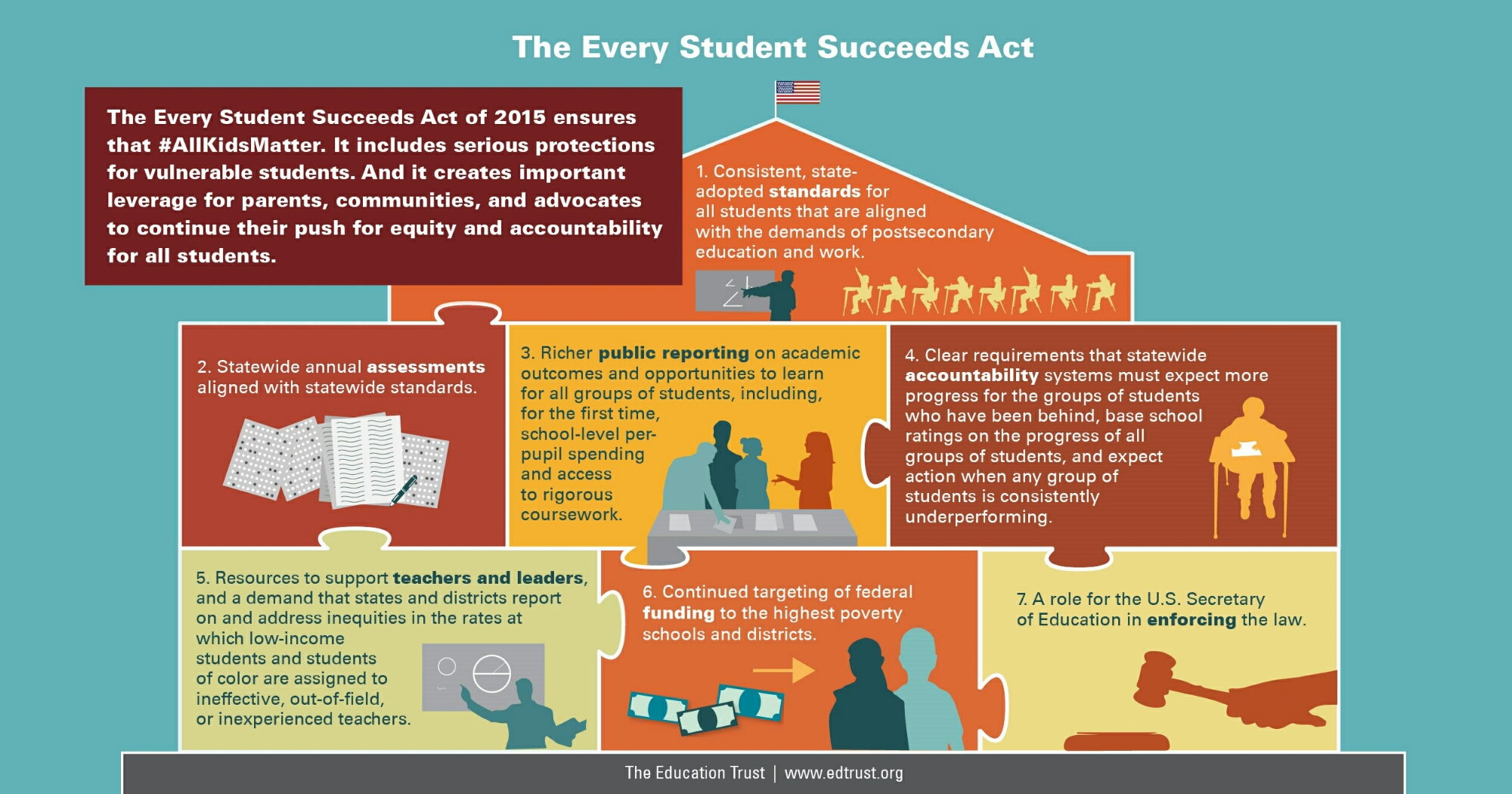
Point five and six are probably the most important. Five acknowledges that while parents play a huge role in their children’s academic development, ineffective teachers, consecutive ineffective teaching in particular teaching, is a huge problem in low income, minority school communities. Now, this isn’t to say I agree that three consecutive years of “good” teaching is sufficient to close the achievement gap. Nor does it mean that I’m in favor of punishing teachers who aren’t continuosly meeting academic goals. I entirely understand that there are many factors that play into how “effective” a teacher is. A lot of that lack of effectiveness has to do with a lack of effective professional development for teachers. What point five really highlights, to me, is the importance of mending this cycle that keeps the most disadvange students with the most ineffective teachers. A good start would be to track and follow how that cycle works, where it’s most pronounced and note any identifiable causes.
This sort of leads into the importance of point six, which is continued funding to low income communties. Im not too clear on what this funding includes specifically, but hopefully there’s an emphasis on Title II funding, which supports teachers’ professional development.
Brief Comment on Paul Tough’s How Children Succeed
In How Children Succeed, Paul Tough walks us through the chemical proccesses of children who have been through traumatic experiences and how those emotions, if not catered to, can affect not only a students education but lifelong experiences. Whle he also talks about how character, especially grit, can help children become more effective students, and in turn, better citizens, I love his emphasis on the role of the parent.
As far as students underperforming on exams goes, a lot of people blame teachers and are either ingnorant or too politcal-minded to rest some of that blame on parents. His last chapter, titled “A Better Path”, note how parents and role models play a significant position in a child/young adult’s mental development. These relationships are almost always personal and are better developed through one-on-one interactions. Some public school teachers are trying to aid 30 kids to a class, 45 minutes at a time, making it difficult to cultivate a personal, on-going relationship. Parents, however, are able to interact with their kids more frequently and for a much longer period of time than any single teacher ever could.
This has always been my train of thought, but I love how Tough essentially says that parents do not need to be academically inclined to make their child a better student. Providing them with the understanding of hardwork, optimism, curiosity and a sense of protection, parents can be one of their child’s most powerful resources, not neccessarily a teacher (…though of course they play a big part, as well).
Success Academy Teacher Degrades First Grader, Maskowitz Defends
The New York Times published a video of Charlotte Dial, a Success Academy teacher, rip up a six year old’s work, while yelling at the girl in front of her whole class. The video shows a softspoken girl answering a question incorrectly, which caused Dial to explode. Dial sends the girl to a time-out chair, isolating the student from everyone else. The student calmly and respectfully listens to her teacher.
You’d think from Dial’s disgusting tone of voice that the girl used profane language or coughed in her face. What’s more is that the girl wrote the right answer on her sheet but did not express that to her classmates when Dial requested. Dial could have easily said to the girl, “Sweetie, I know you know the right answer. I saw your work and I am proud of it. Can you please explain to the class how you did it? We’d all love to hear your explaination.” Even if the student contitnued to not give Dial the right answer, Dial could have said, “That’s okay. We’ll come back to you next time.” Dial could have proceeded to have a side conversation with the student and her parent about her public speaking abilities.
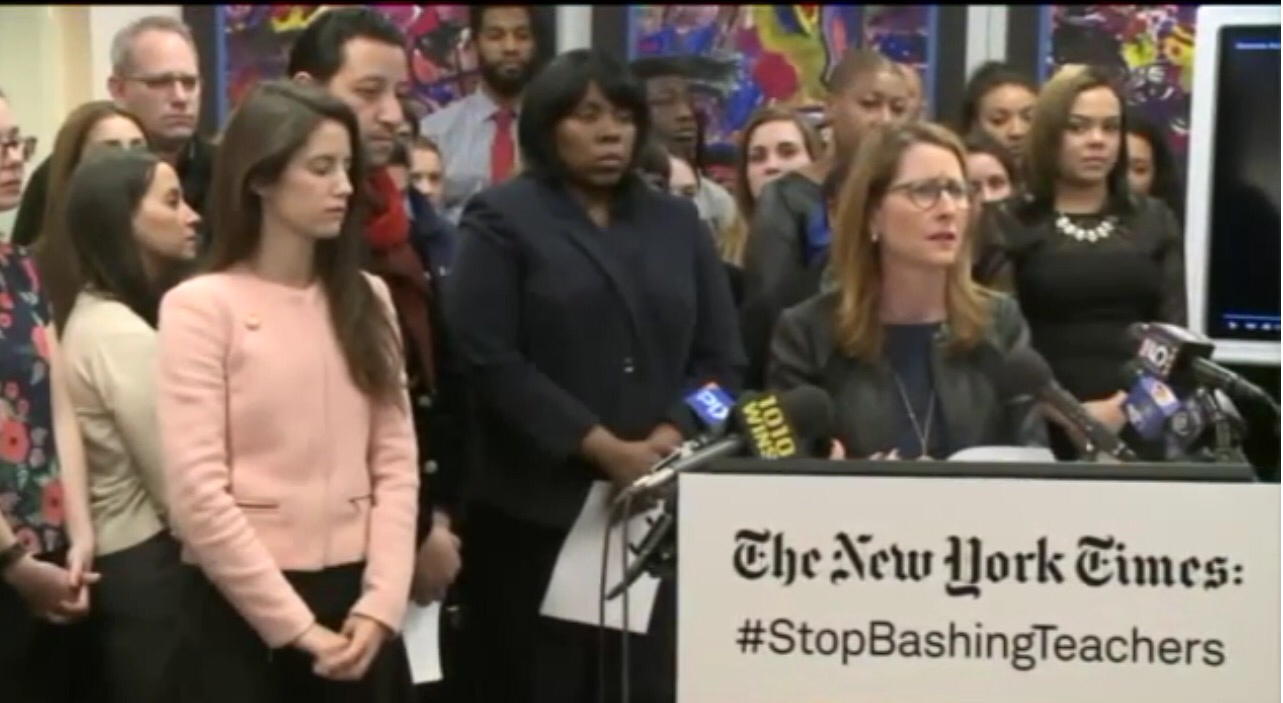
In repsonse to the video, Eva Maskowitz, President of the 30+ Success Academy Charter network, held a press conference and went as far as saying that she was not going to throw Dial under the bus. Some may not find that disturbing, but the Times‘ video was secretly recorded by Dial’s former teacher assistant, who said that Dial behaved in a belittling and condescedning manner quite often. Maskowitz, at the conference, in her typical manner, disregarded the assitant’s direct experience with working with Dial, and insisted that this was a one time mistake for Dial. Maskowitz even went as far as calling out the NYT, using a sign on the speaker’s podium that read: The New York Times: #StopBashingTeachers
I think that it is shocking that when a newspaper distributes clear proof of what is said to be happening in some successful charter schools, one should not blame the publisher or its source for doing their job. Regardless of whether it was a one time incidient or not, she should pay the consequences for her ill-behavior and take responsibility for her wrongdoing. Besides, is it teacher bashing when the teacher clearly degraded a smart child in front of her entire class? Sounds to me like it is the other way around.
While Maskowitz talked about all of the pain Dial is going through as a result of her getting caught treating a child with such low regard, no one talked about the trauma the smart girl must have felt when her teacher publicly bashed her for her shy ways…it pains me how Maskowitz completely misses the point of the NYT article.
Elizabeth Warren on Lack of Enforcement of Major Breaches
You gotta love Elizabeth Warren! Her January NYT article reviews some of the biggest breaches of law that our government actively fails to enforce, even when millions of dollars have been knowingly tossed away for the sake of profit. She gives examples where companies out right commit fraud and are only given fees that the companies have no issue with paying–often times, the profits they reaped from breaking the law these companies far more money than the fine they had to pay.
While her examples are aimed a financial institutions, she makes sure to point out how mismanagement, distribution of inaccurate information and the loss of millions of dollars were occurring in both the pharmaceutical and educational industries.
She gave used EMC as an example:
When the Education Management Corporation, the nation’s second-largest for-profit college, signed up tens of thousands of students by lying about its programs, it saddled them with fraudulent degrees and huge debts. Those debts wrecked lives. Under the law, the government can bar such institutions from receiving more federal student loans. But EDMC just paid a fine and kept right on raking in federal loan money.
As I always say, I’m deeply troubled why anyone would think for-profit schools can effectively work in favor of their students when they make financial promises to shareholders.
CT Governor Cuts $52 Million From Pub School Funding
Hey, I have a great idea: lets substantially decrease funding where it’s needed most and increase it where more funding can be provided by ready and willing philanthropists! Or, we can take the Governor of Connecticut’s lead:
Charter schools have escaped Gov. Dannel P. Malloy’s budget knife and are slated for a $9.3 million boost in his newly proposed state budget.
But the Democratic governor also wants a $52.9 million [emphasis mine] cut in funding for special education, after-school programs, reading tutors and other services in low-performing public schools across the state.
Read the full article here.
School Uses Time to Create Positive Culture
Great post on the MindShift blog. During a student’s advisory time, she sits with a group of her peers and has the opportunity to discuss everything from current school assignments to dealing with stress. This practice would be great to introduce on the first day of high school (or any K-12 grade) because the students start to develop a sense of community and hopefully understanding and awareness of their other classmates concerns before they get too caught up in their own high school life. More importantly, it turns the attention from what a student does/doesn’t know to what she needs to express. Students are in school five days a week, eight hours a day. At some point in their school, they should have a moment to slow down and work their projects and concerns out in that same environment, so that the school environment becomes a place where support, on multiple levels, can occur. This kind of group practice acknowldegs that students are more than their school work and that other students have similar concerns but dont know how/if it’s okay to express them. The school should act as a facilitator because teenagers are still growing into themselves. Schools should lead by example and understand that This kind of positive atmosphere, I’m sure, gets carried over to other classes, if only for a few students.
DOE Denies 2 For-profit Schools Financial Aid
Computer Systems Institute and Marinelli School of Beauty, two for-profit networks, were denied financial aid funds for their gross financial misconduct.
…why are for-profit schools able to soak up federal funds to begin with? There’s no way a school can do the best for there students while trying to please miney hungry shareholders.
Click here for more.
On Flint’s Water Crisis and Education
What is happening in Flint, Mchigan is an awful example of how some elected officials treat the children they represent. It’s not just in the schools system but in other aspects of their lives, as well. Why would we expect the governor of Michigan to care about the quality of public school education when he knowingly acted against their health, of all critical aspects of a persons life.
 On Education: Curriculum, Equity & Public Education