Never About Equal Opportunity

“Whether they were born to poor white Appalachians or to wealthy Texans, to poor black people in the Bronx or to rich people in Manhasset or Winnetka, they are all quite wonderful and innocent when they are small. We soil them needlessly”

– John Kozol, 1991

This is terribly true, but we’re too much of a capitalist country for all students to even have a some  what equal opportunity.

From “Savage Inequalities”

Here’s a quote from the education policy classic Savage Inequalities:

We are preparing a generation of robots. Kids are learning exclusively though rote. We have children who are given no conceptual framework. They do not learn to think, becuase their teachers are straightjacketd by tests that measure only isolated skills. As a result, they can be given no electives nothing wonderful or beautiful, nothing that touches the spirit or the soul. [emphasis mine]

This is a quote from a Camden, New Jersey public high school principal. The sad part is that, if you read the quote today, and had no context, you wouldn’t be able to tell it was said in 1990. There are far too many public schools operating the same way today. Jesus. When will it get better?

“The Walmartization of Public Eductaion”

Here’s a fantastic article about the Walmart Family Foundation’s expanion of their hellbent support of charter schools. If you don’t want to read the whole article, skip to the last few paragraphs. The author, Valerie Strauss, makes a key point. She essentially says it doesn’t matter if you’re pro or anti charter schools. It doesn’t matter if you’re in between. What does matter is where each community stands on the matter and due to the Walmart Family Foundation’s heavy funding, with no regard to what communities want, this is just another example of the Man forcing his own, self-centered beliefs on (in this case) a mass group of people. As Strauss questions, how is this democarcy when a hanful of people are deciding our country’s educational future?

S.A.’s Got-to-Go List’s Lawsuits

Success Academy refused to provide a five year old with adequate services to address his learning disabilities. Instead, they sent him home for early dismissal and called his parents nearly every day because he ciolated the Academy’s Code of Coduct. What’s more is that even after he the school formalized a plan that could remedy his disabilities (at least to a certain extent), they refused to actually put those simple remedies, such as deep breathing tactics and taking short walks, in place. They did not want to bend their strict Code of Conduct, which entails sitting upright at all times. Eventually, I.L.’s (he’s called I.L. for privacy) parents were told that I.L. was “not a good fit” for the school. I.L.’s parents removed him from the school.

I.L. was one of the students on the Sucess Academy-Fort Greene’s-should-be-infamous “Got to Go” list, which targeted students with learning and behavioral disabilities for permanant removal. His parents are suing the school, which is fantastic because now we can get a closer look at the gross injustices that students with learning disabilities face at militaristic charter schools. But it’s sad that Success Academy, with all its resources, doesn’t truly take the time  to help them. The initial idea behind charter schools was for them to work more closely with kids who have learning and behavioral problems. It’s clear by this list that Success Academy only cares about the students who are “willing to learn.” It also adds to the idea that charters push out the “bad” kids and use the public school system as a “dumpsite. Read more here.

Still The Same: Social Services Support

I’m currently reading Alex Kotlowitz’s nationally acclaimed book, There Are No Children Here, a book that displays the harsh affects that poverty has on children who live through it, day in and day out. Kotlowitz starts off by focusing on the violent and burdensome social lives of Lafayette and Pharoah Rivers but then dovetails into very important aspects of the poverty story that has often been said to not be affected by poverty: the school and education of the impoverished child.

Kotlowitz, before describing and connecting the affect that poverty has on Lafayette and Pharoah’s education, gives a general summary of what little resources the principal and teachers have to work with.

“Also, Suder [one of the local schools serving the few thousand kids growing up in the crime infested Horner projects] must share a nurse and psychologist with three other schools and a social worker with four other schools.”

Not only do the children live in poverty, but the schools themselves operate and function in poverty.

But this sentence resonated with me for another reason. My high school severed students from three large project developments. Even though these projects were similar, though less dangerous than Horner, it was obvious that a large number of my fellow classmates were behaviorally troubled because of their environment. What’s more is that my high school in 2010 shared a social worker with three other high schools, like Horner in 1987. Nearly a quarter of a century later and we still can’t admit that not acknowledging poverty as a real detriment to students academic and social success has much to do with why children who live through it can’t break the cycle.

I admire this book, because like How Children Succeed, it acknowledges that education needs more than “better” teachers. The problem is far more complicated than that.

Mini-Documentaries More Beneficial in Schools Than Lengthy Films

Short, precise and well thought out documentaries can be more useful and efficient alternatives to time sucking films, according to the NYT‘s “Film Club”, which produces 8-12 minute long mini-documentaries that are aimed at adding onto how students take in and reflect on various subjects.  I love the article’s emphasis on critical thinking skills. Each mini-documentary comes with supplement materials that help facilitate a conversation about topics such as the documentary’s purpose and individual student’s personal reflection and reaction to a documentary. But, what I think is more important is the encouragement for students to write down quotes or note parts that stood out to them. I think this is a great opportunity to allow students to pay attention and find what appeals to them (or what doesn’t) and then try to articulate (either orally or writing) why they feel the way they do. Rather than watching an hour long film, students can spend the class period watching a ten minue mini-documentary, five minutes on individual reflection, then break out into mini groups discussing their thoughts and answering questions tailored to provoking critical thinking skills. The teacher would pop-in on each group’s session, taking note of each students oral articulation skills and provide feedback to the student on a one-on-one basis at some point before week’s end.

I’m Working with Sophomores to Prepare for the PSAT

This week, I started a new tutoring program that helps sophomore high school students prepare for the PSAT. As noted a number of times in the past, I majored in English, and so I help two students improve their verbal PSAT score(they took a pre-PSAT). These students were recommended by their guidance counselors and deemed as those on the college track. Generally speaking, these students are minorities in public schools that are subpar. Generally speaking, they’re relatively shy but encouragingly focused and career oriented. They’re motivated and have an understanding that they can have a beautiful life years from now, if they work hard now.

The issue I found, despite all these glorious traits, is that they didn’t know how to use commas or semicolons. They couldn’t write four concise consecutive sentences. And when asked how they could make their weakly connected sentences better, they had no clue how to.

Time is an issue here. The time I have with them is supposed to be used to teach them how to take the PSAT in twelve hours across twelve weeks. But, I cant jump into how to take the test when they’re not well versed on the basics. I don’t know how to ignore that deficiency, and they deserve more than that. I’ll just spend a few hours on the basics and  then end that chapter of the class with a quiz, one on one assesment and then continous feedback on whether the fundmenatals are becoming a part of their new standard.

One thing I can say about why this project is so exciting is that they were wowed when we worked towards strengthening those weak sentences and after we made these sentences better, they had a look, an expression of now understanding something they didn’t know they didn’t know.

Infographic: Outline of ESSA Goals

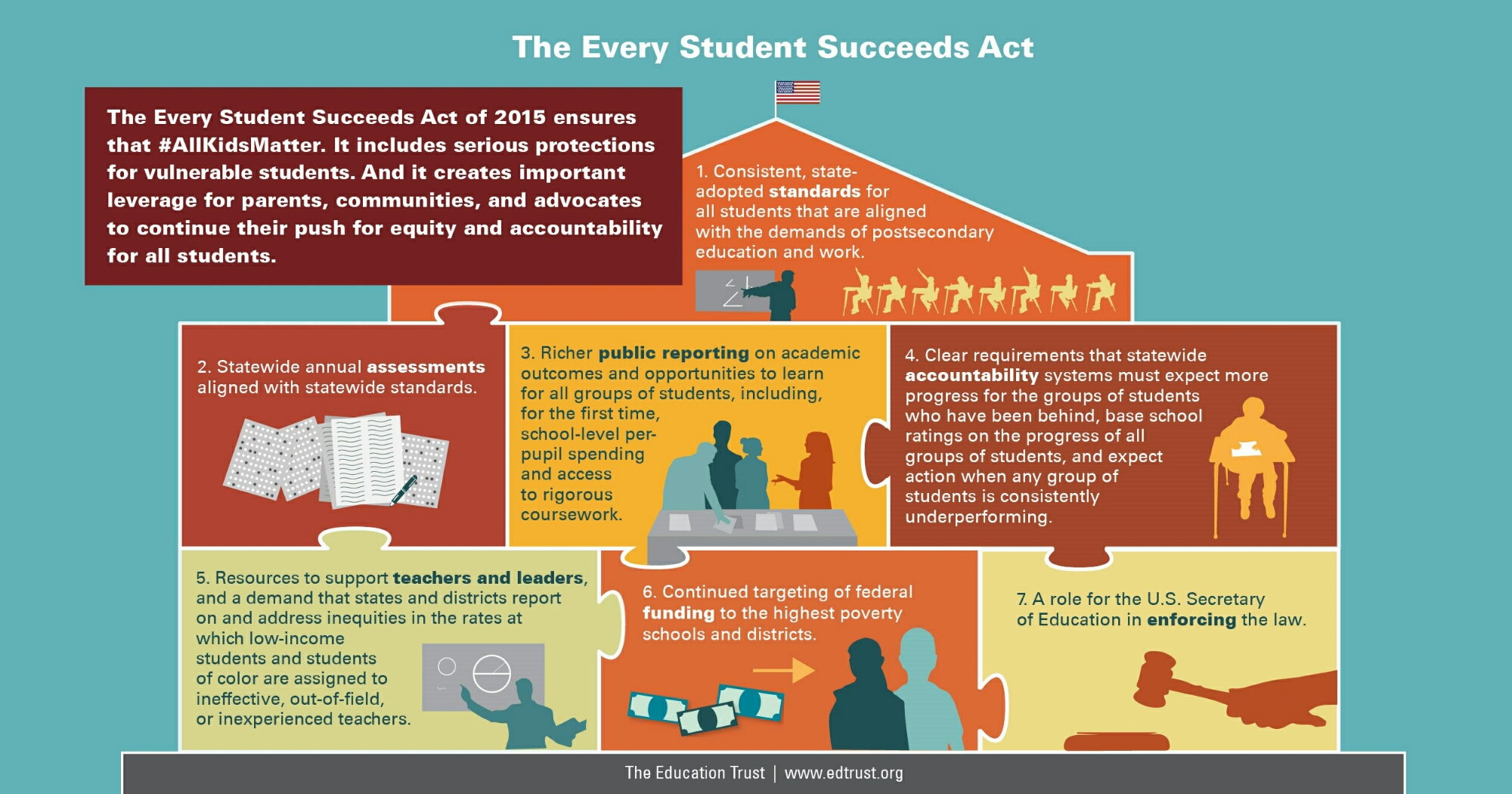
Here’s an EdTrust infographic about the seven key goals of ESSA.  Thoughts on two of my favorite points are below the infographic.

image

Point five and six are probably the most important. Five acknowledges that while parents play a huge role in their children’s academic development, ineffective teachers, consecutive ineffective teaching in particular teaching, is a huge problem in low income, minority school communities. Now, this isn’t to say I agree that three consecutive years of “good” teaching is sufficient to close the achievement gap. Nor does it mean that I’m in favor of punishing teachers who aren’t continuosly meeting academic goals. I entirely understand that there are many factors that play into how “effective” a teacher is. A lot of that lack of effectiveness has to do with a lack of effective professional development for teachers. What point five really highlights, to me, is the importance of mending this cycle that keeps the most disadvange students with the most ineffective teachers. A good start would be to track and follow how that cycle works, where it’s most pronounced and note any identifiable causes.

This sort of leads into the importance of point six, which is continued funding to low income communties. Im not too clear on what this funding includes specifically, but hopefully there’s an emphasis on Title II funding, which supports teachers’ professional development.

https://edtrust.org/the-equity-line/although-essa-provides-more-flexibility-feds-must-remain-steadfast-on-equity/?utm_source=Equity%20Express&utm_medium=Email&utm_content=ESSA&utm_campaign=ESEA

Founding Fathers on Public Education

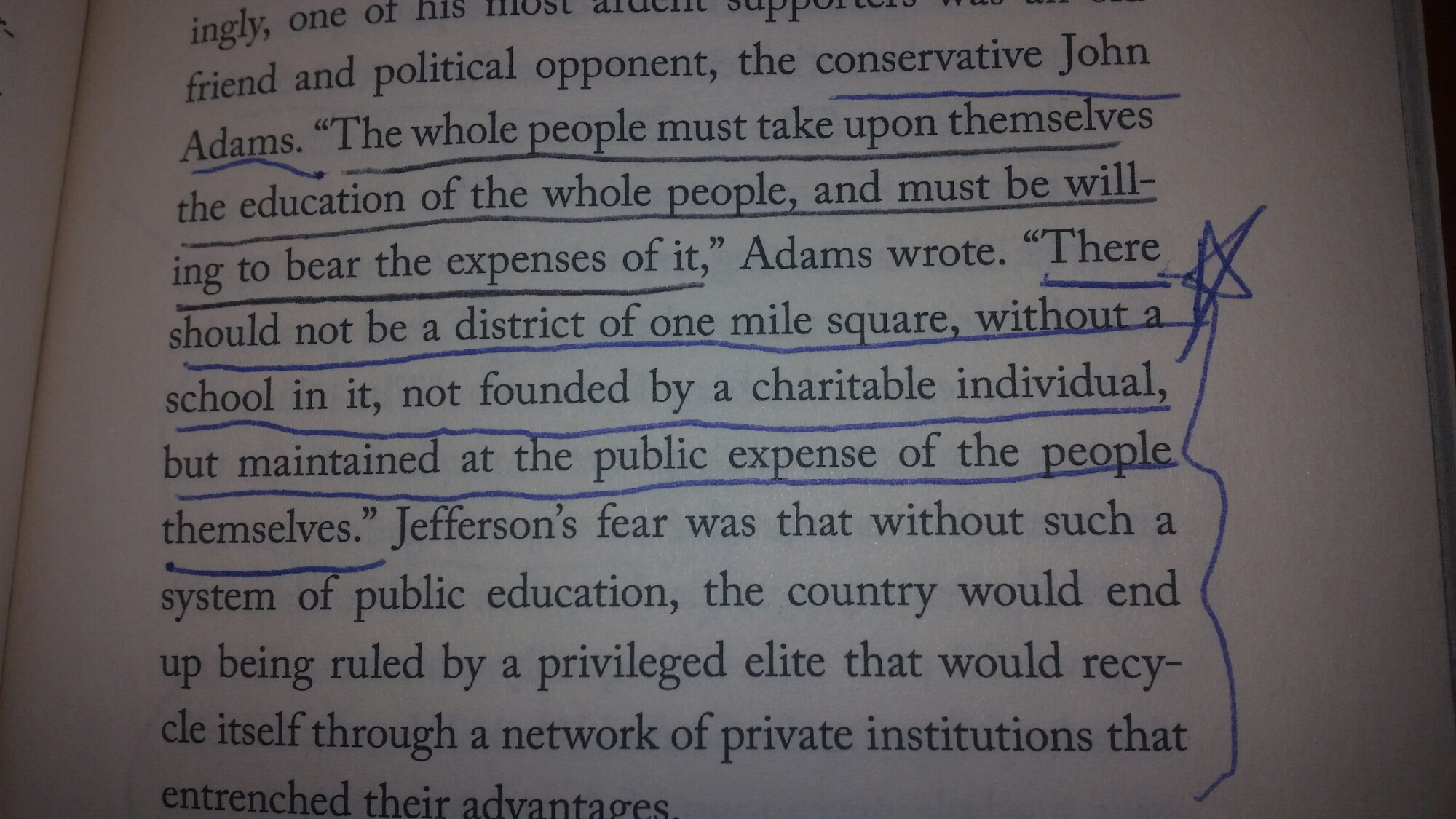
I’m currently reading Fareed Zakaria’s In Defense of a Liberal Education and came across two quotes from this country’s founding fathers on the purpose of public education. Keep in mind that the commenting founding fathers, Thomas Jefferson and John Adams, couldn’t possibly conceive of the charter school system, which is both a public and private entity. But, based on these quotes, one could imagine how they’d feel about the Broads, Gates and Waltons of the country making overreaching education policy changes with their wealth.

image

Brief Comment on Paul Tough’s How Children Succeed

In How Children Succeed, Paul Tough walks us through the chemical proccesses of children who have been through traumatic experiences and how those emotions, if not catered to, can affect not only a students education but lifelong experiences. Whle he also talks about how character, especially grit, can help children become more effective students, and in turn, better citizens, I love his emphasis on the role of the parent. 

As far as students underperforming on exams goes, a lot of people blame teachers and are either ingnorant or too politcal-minded to rest some of that blame on parents. His last chapter, titled “A Better Path”, note how parents and role models play a significant position in a child/young adult’s mental development. These relationships are almost always personal and are better developed through one-on-one interactions. Some public school teachers are trying to aid 30 kids to a class, 45 minutes at a time, making it difficult to cultivate a personal, on-going relationship. Parents, however, are able to interact with their kids more frequently and for a much longer period of time than any single teacher ever could. 

This has always been my train of thought, but I love how Tough essentially says that parents do not need to be academically inclined to make their child a better student. Providing them with the understanding of hardwork, optimism, curiosity and a sense of protection, parents can be one of their child’s most powerful resources, not neccessarily a teacher (…though of course they play a big part, as well).